


As time progresses and knowledge accrues, the football analytics community, like any scientific — or at least science-adjace — endeavor, tends to spend more and more of our time digging deeper and deeper into the data in search of finer and finer granularity as the edges get thinner and thinner. We sometimes lose the wood for the trees, and so it behooves us to zoom out every so often.
In that vein, I found something while working on projecting league averages for this upcoming season that was worthy of communicating to those interested. Namely, the passing efficiency boom over the past decade has been due in large part to running backs (RB). Which is kinda problematic because it’s received wisdom in our community that running backs don’t matter: In a real-world football context, they don’t; and in a fantasy football context, they don’t.
Given this anomaly, and for the sake of due diligence, I searched Google to see if any fellow nerds had already reported on this. I found only these two articles, which are circling around the target, but aren’t entirely on point:
- The Rise of the Pass-Catching Running Back by Ben Linsey
- How to Use a Running Back in the Passing Game by Danny Kelly
Linsey showed that RB receiving production has increased over time, culminating in a record-setting season in 2018. Kelly, meanwhile, argued that said increased production was based on both increased usage and increased average depth of target (aDOT). These were important additions to our body of knowledge. Having said that, what neither article did was go one step further, showing not just that RB receiving production has increased (and why), but showing that RB receiving efficiency is basically all that’s increased relative to the other receiving positions.
Data
I combined Pro Football Focus’ fantasy stats database and PFF’s Yards per Route Run (YPRR) database to create a data set from 2006-2018 comprising
- 7,633 quarterback (QB) game logs
- 19,639 RB game logs
- 25,199 wide receiver (WR) game logs
- 12,536 tight end (TE) game logs
Results
First, it’s worth doing a sanity check with respect to the existence of a passing efficiency boom:
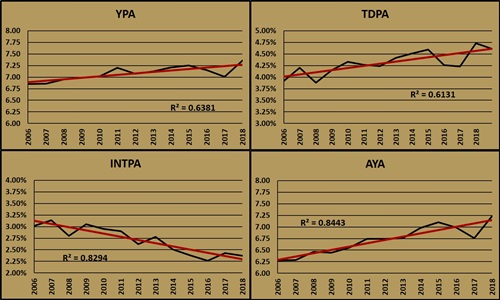
Sanity? Check. Yards per Attempt (YPA) has increased, Touchdowns per Attempt (TDPA) has increased, and Interceptions per Attempt (INTPA) has decreased; all significantly. And combining these three stats into Pro Football Reference’s Adjusted Yards per Attempt (AYA) makes the passing boom picture even clearer.
Alright, so YPA and TDPA have increased significantly since 2006, which means passing efficiency has increased significantly. So you’d figure receiving efficiency for WRs has increased significantly, right?
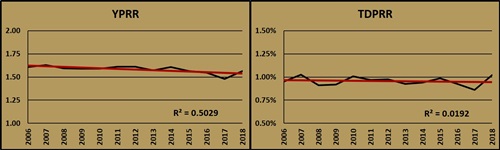
Wrong. Touchdowns per Route Run (TDPRR) hasn’t risen since 2006, while Yards per Route Run (YPRR) has actually decreased.
OK, so perhaps you’d figure receiving efficiency for TEs has increased significantly, right?
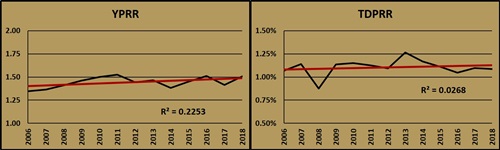
Wrong. Neither YPRR nor TDPRR has risen significantly since 2006.
So with receiving efficiency for WRs and TEs being either down or flat since 2006, that leaves RBs to explain the passing efficiency boom. And yep, boom!
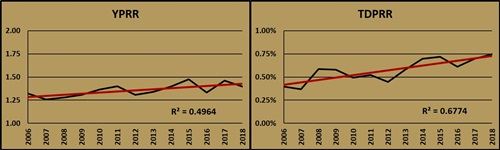
Not only has RB receiving production increased, as others have reported; RB receiving efficiency has increased. And not only that: Unlike WRs and TEs, RB receiving efficiency has increased concomitant with the passing efficiency boom.
Discussion
Astute readers may be yelling at the screen, “Wait, might aDOT explains all this?” Well, yes! Yes, astute reader! Here’s a comparison of aDOT between the receiving positions since 2006:
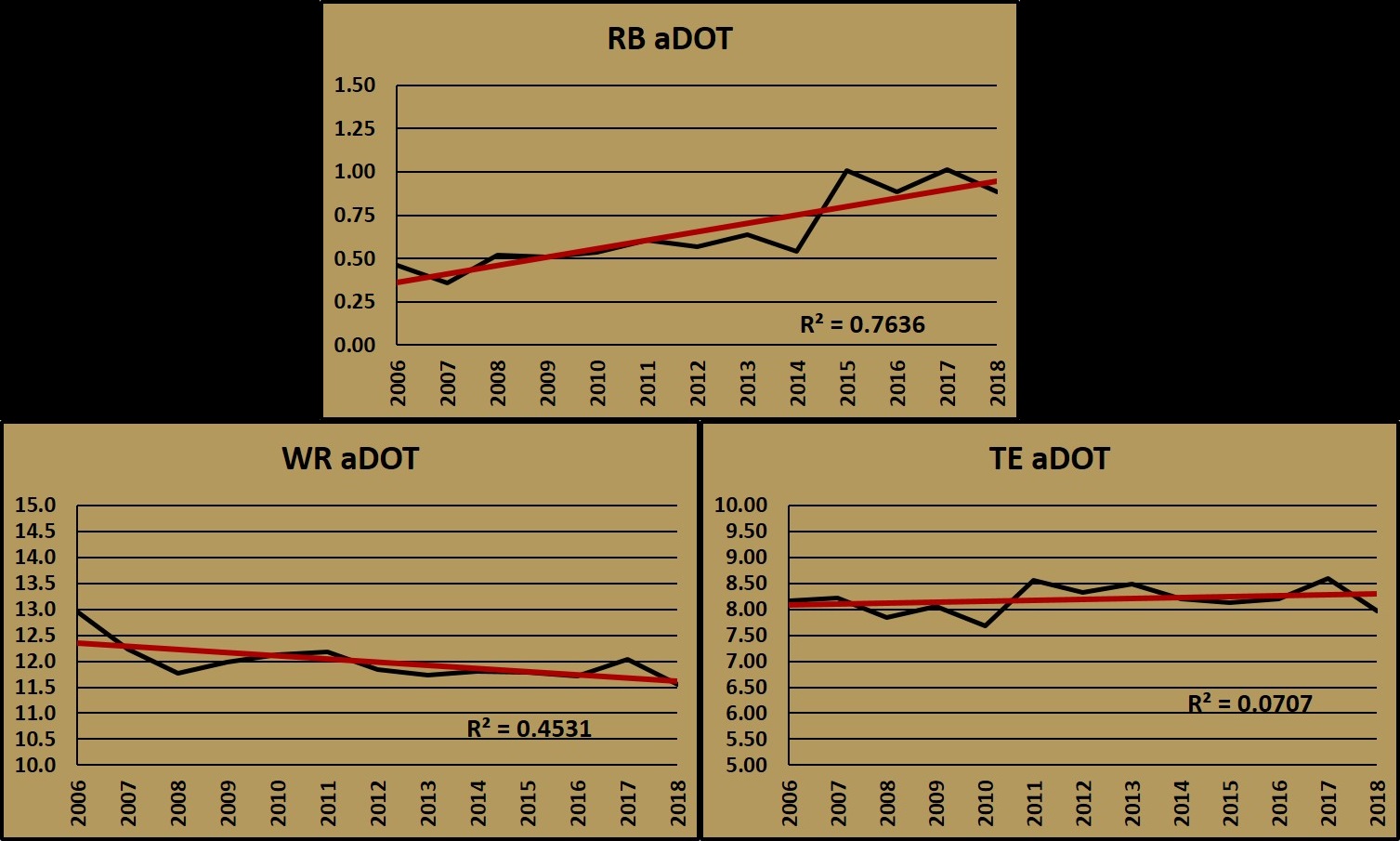
RBs are way up, WRs are down, and TEs are flat.
DT : IR :: TL :DR
Sometimes we lose the wood for the trees. Yes, we know production and efficiency via the passing game has increased considerably since 2006. And some know that there’s been an increase in RB receiving production. Having said that, there’s more importantly this:
- RB receiving efficiency has increased.
- RB is the only position to have seen a receiving efficiency increase.
Therefore, the boom in pass efficiency has been primarily due to RBs. And therefore, (receiving) RBs matter.